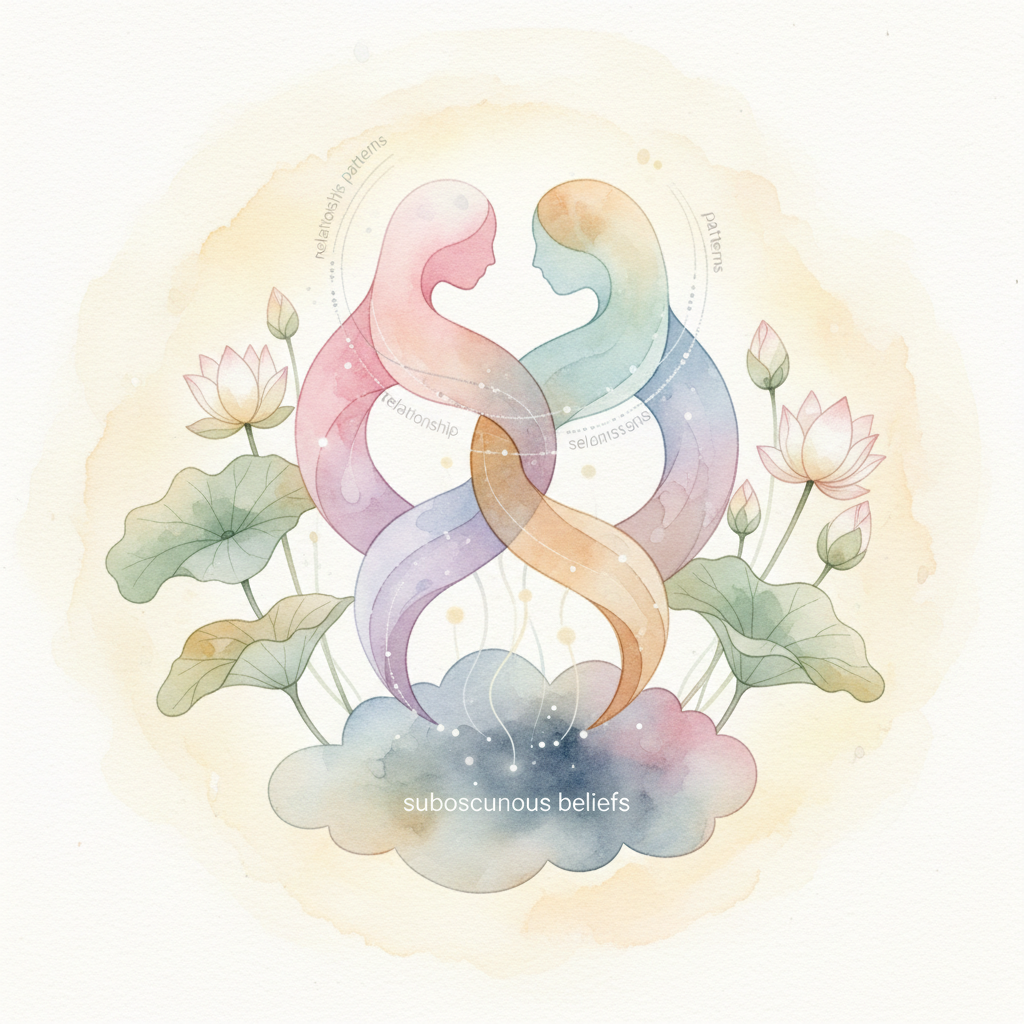
Relationship Patterns: How Subconscious Beliefs Shape Your Love Life
The dance of relationships is a complex and often beautiful one, yet for many, it feels like a perpetual stumble. We find ourselves repeating the same arguments, attracting similar types of partner...
The dance of relationships is a complex and often beautiful one, yet for many, it feels like a perpetual stumble. We find ourselves repeating the same arguments, attracting similar types of partners, or experiencing the same frustrations, even when we consciously desire a different outcome. It's as if an invisible force is guiding our steps, pulling us back to familiar, sometimes painful, patterns. At InnerShift, we understand that this invisible force often resides deep within our subconscious mind – a powerful, unseen architect shaping our love lives.
The Blueprint of Beliefs: How Your Subconscious Operates
Think of your subconscious mind as a vast, intricate library, meticulously cataloging every experience, every interaction, every word spoken to you and about you, especially during your formative years. From these experiences, it constructs a unique "blueprint" of beliefs about yourself, others, and the world. These beliefs, often formed before conscious reasoning fully develops, become the filters through which you perceive reality.
For instance, if you grew up in an environment where love was conditional, your subconscious might have internalized the belief, "I am only worthy of love if I achieve X" or "Love always comes with a price." Conversely, if you witnessed a healthy, supportive partnership, your subconscious might hold the belief, "Love is a safe and nurturing space." These deeply ingrained beliefs, whether empowering or limiting, operate beneath the surface of your awareness, profoundly influencing your choices, reactions, and expectations in relationships.
Research consistently highlights the profound impact of early experiences on adult attachment styles and relationship dynamics. A seminal study by Hazan and Shaver (1987) demonstrated how early childhood experiences with caregivers predict adult romantic attachment styles – secure, anxious-preoccupied, or dismissive-avoidant. These attachment styles, essentially subconscious relationship blueprints, dictate how we approach intimacy, handle conflict, and perceive our partners' intentions.
Unpacking Common Subconscious Relationship Patterns
Let's explore some common ways these subconscious beliefs manifest in our love lives:
-
The Fear of Abandonment: This often stems from early experiences of perceived or actual abandonment, leading to a subconscious belief like, "Everyone I love will eventually leave me." In relationships, this can manifest as clinginess, excessive jealousy, or a tendency to push people away before they can "abandon" you. You might find yourself constantly seeking reassurance or interpreting minor disagreements as signs of impending departure.
-
The Need to "Fix" Others: If your subconscious holds the belief, "My worth is tied to helping others," you might repeatedly find yourself drawn to partners who seem to need rescuing. While compassion is admirable, this pattern can lead to imbalanced relationships where you constantly give, and your own needs are neglected. This often stems from a childhood where you felt responsible for a parent's happiness or well-being.
-
The Cycle of Self-Sabotage: Do you find yourself getting close to a truly fulfilling relationship, only to suddenly create distance, pick a fight, or find a "fatal flaw" in your partner? This could be a subconscious belief at play, such as, "I don't deserve true happiness" or "Intimacy is dangerous." This self-sabotage protects you from the perceived risks of vulnerability and deep connection, even if it leaves you feeling lonely.
-
Attracting the "Same Type": Many people lament, "I always attract the same kind of person!" This isn't usually a coincidence. Your subconscious, seeking familiarity and operating from its established blueprint, might be unconsciously drawn to partners who reinforce existing beliefs, even if those beliefs are detrimental. If your subconscious believes "Love is chaotic," you might repeatedly find yourself with partners who bring drama into your life.
The Science Behind Subconscious Influence
Neuroscience offers compelling insights into how these patterns become entrenched. Our brains are wired for efficiency, creating neural pathways for frequently repeated thoughts and behaviors. When a belief is consistently reinforced, whether through personal experience or observation, the neural pathways associated with it become stronger and more efficient. This makes it easier for the brain to default to these patterns, even when they are unhelpful.
Furthermore, the amygdala, our brain's "threat detector," plays a significant role. If past relationship experiences have been painful or perceived as threatening, the amygdala can become hyper-vigilant, triggering fight, flight, or freeze responses in current relationships, even in the absence of real danger. This can lead to overreactions, defensiveness, or emotional withdrawal, all driven by subconscious protective mechanisms.
Shifting the Blueprint: Practical Steps for Change
The good news is that your subconscious blueprint is not set in stone. While deeply ingrained, it can be rewired. Here's how you can begin to shift these patterns:
-
Become a Detective of Your Own Patterns: The first step is awareness. Start observing your relationship dynamics without judgment. What arguments do you repeat? What feelings consistently arise? What types of partners do you repeatedly attract? Journaling can be an incredibly powerful tool for uncovering these patterns. Ask yourself: "What belief might be driving this behavior?"
-
Identify Limiting Beliefs: Once you've identified a pattern, try to trace it back to a core belief. For example, if you constantly feel unappreciated, the underlying belief might be, "My needs don't matter." Be honest with yourself, even if the belief feels uncomfortable to acknowledge.
-
Challenge and Reframe: Once a limiting belief is identified, consciously challenge its validity. Is it truly 100% accurate in all situations? Can you find evidence to the contrary? Then, reframe it into an empowering belief. Instead of "My needs don't matter," try, "My needs are important, and I deserve to have them met."
-
Practice New Behaviors: Beliefs are reinforced by actions. Start consciously practicing behaviors that align with your new, empowering beliefs. If your new belief is "I am worthy of healthy love," begin setting boundaries, communicating your needs, and choosing partners who respect them. This might feel uncomfortable at first, as you're stepping outside your subconscious comfort zone.
-
Cultivate Self-Compassion: Changing deeply ingrained patterns takes time and patience. There will be moments of regression or frustration. Treat yourself with kindness and understanding. Remember that these patterns were formed as protective mechanisms, even if they no longer serve you.
-
Seek Professional Guidance: This is where hypnotherapy can be profoundly transformative. While conscious effort is crucial, accessing and reprogramming the subconscious directly can accelerate the process. Hypnotherapy provides a gentle yet powerful way to communicate with your subconscious mind, identify the roots of limiting beliefs, and install new, empowering ones. It helps you bypass the conscious mind's resistance and directly address the underlying programming that dictates your relationship patterns.
By understanding and actively working with your subconscious mind, you can move from being a passive participant in your love life to becoming its conscious architect. You have the power to rewrite your relationship blueprint and create the fulfilling, loving connections you truly desire and deserve.
Ready to explore how your subconscious beliefs are shaping your love life and learn how to create healthier, more fulfilling relationships? InnerShift offers personalized hypnotherapy sessions designed to help you uncover and transform limiting beliefs. Visit our website today to learn more and book your complimentary consultation.
Get Weekly Wellness Tips
New hypnosis sessions, mindfulness techniques, and evidence-based wellness insights delivered to your inbox.
No spam. Unsubscribe anytime.